
13 de noviembre de 2025
This marks the fourth final loss of the year for the world’s top-ranked pair. The question arises: is this a coincidence or a pattern?
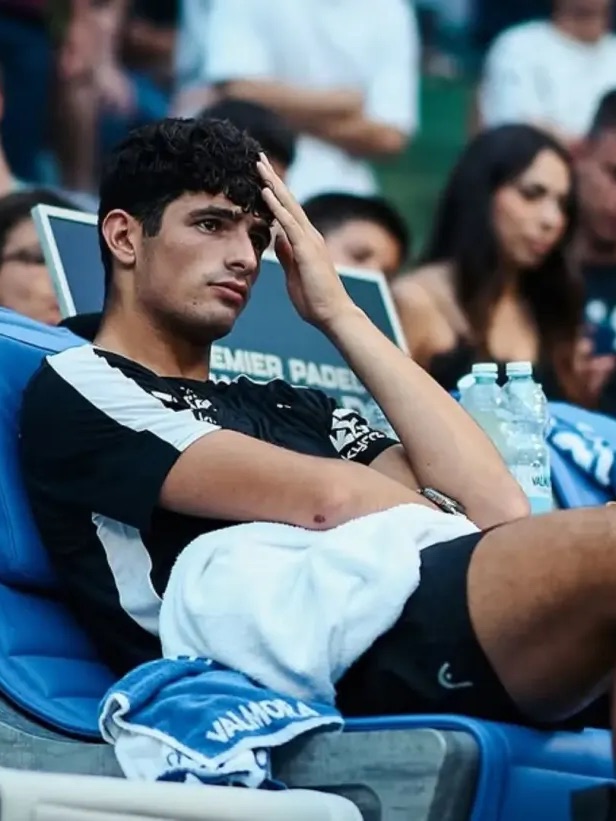
At the recently concluded FIP Kuwait World Pairs tournament in Kuwait, some familiar faces met once more in the final. The world number ones, Arturo Coello and Agustín Tapia, tried to stop Federico Chingotto and Alejandro Galán, who are in phenomenal form.
This tournament carried special significance — the number of ranking points it offered was equivalent to a Major. The “Golden Boys” Coello and Tapia even skipped the previous, less prestigious stage in Egypt to better prepare for Kuwait. But the strategy didn’t pay off: the match was almost a mirror of the Milan final — a confident start from Arturo and Agustín, a turning point in the second set, and then complete dominance by their opponents in the decider. This marks the fourth final loss of the year for the world’s top-ranked pair. The question arises: is this a coincidence or a pattern?
The key: court speed
There is a clear trend, and the key lies in the speed of the court. All four finals the world number ones lost were played on slow courts.
Court speed is influenced by many factors: natural (humidity, temperature, altitude) and technical (type of surface, amount of sand, base material).
-
Fast courts favor attacking players — the ball comes off the surface more easily, and finishing shots are more effective.
-
Slow courts favor technical and patient players, who can defend and construct points strategically.
During the Kuwait tournament, a Spanish padel blogger conducted a viral experiment: he dropped the same ball from the same height on both the central court and Court 2. The difference in bounce was so obvious that it became clear — the central court was significantly slower. And this happened within the same tournament! Many considered it an oversight by the organizers, but in my view, it was a deliberate decision. The hosts didn’t want another routine win by Coello and Tapia; they aimed for a more entertaining and unpredictable battle — and they got exactly that.

Padel is changing
Padel is a young and rapidly developing sport. Everything is changing: the calendar, the rules, the technique, the tactics. But most importantly, the style of play is evolving.
Over the past 20 years, padel has moved from a slow, defensive format to a dynamic, aggressive, and spectacular game.
For example, when Fernando “Bela” Belasteguín and Juan Martín Díaz dominated the sport, hitting the ball out of the court was almost a feat. Most points were won through technique and strategy, not power. Today, it’s the opposite: those who rely on powerful attacks set the trend and win titles. But that makes the game predictable — if the court is fast, the “Golden Boys” win.
Slow courts bring back intrigue
Take Paquito Navarro, for example — a veteran and former world number one. He claims to be in the best form of his career, yet on fast courts he struggles to keep up with the younger players and barely stays in the Top 10. In Giza(where the court was slow), Paquito reached the final; and in Kuwait (where the central court, as we now know, was deliberately slowed down), he repeated that success, this time reaching the semifinals.
The same thing is happening in the women’s circuit. Delfi Brea and Gemma Triay, the embodiment of the attacking style, lost the Kuwait final to the more technical Paula Josemaría and Ariana Sánchez.
Tournament organizers are noticing this correlation and are beginning to regulate match dynamics through court speed. After all, spectacle isn’t just about powerful smashes — it’s also about drama, emotion, and unpredictability.
Where padel is heading
Today, padel stands at a turning point. The era of the absolute dominance of the attacking style seems to be coming to an end. The sport is searching for balance — between speed and technique, between predictability and excitement.
It’s no coincidence that Paquito Navarro himself has proposed:
-
Bringing back the “golden point” rule,
-
Alternating between fast and slow courts,
-
Reducing the number of mandatory tournaments to 16.
Of course, Navarro is also thinking of himself — such measures would extend his competitiveness — but he has sensed the trend accurately.
The return of the golden point also makes sense: it adds an element of unpredictability and shortens match durations, which is especially relevant on slow courts where rallies tend to drag on.

The next tournament, Premier Padel P1 in Dubai, kicks off this week. The organizers promise a fast court, and it’s logical to expect that Coello–Tapia and Brea–Triay will reclaim their titles. But the most important thing isn’t who wins — it’s the direction the sport is taking.
Padel is entering a new phase of development — the phase of intentional control over the game’s dynamics. Now, results depend not only on players’ skill but also on court speed, which means that the balance between power and technique is becoming a matter of design.
This is a sign of the sport’s maturity: padel is beginning to self-regulate, aiming to maintain excitement while restoring unpredictability.
And perhaps, right now, padel is taking its first step from the “era of power” into the era of balance, where victory will belong not just to the strongest — but to the smartest players and organizers alike.